
The Beginner Muscle-Building Diet Plan That Actually Works

Building muscle as a beginner doesn’t require extreme diets or complicated meal plans.
What actually works is eating the right amount of calories, enough protein, and staying consistent.
This guide breaks down a beginner-friendly muscle diet plan in the simplest way possible.
Introduction
This beginner muscle-building diet plan is designed to help beginners gain muscle with simple foods, proper calories, and consistent nutrition. If you’re a beginner looking to build muscle, you don’t need complicated meal timing, extreme diets, or expensive supplements. Muscle growth is driven by consistent training and adequate nutrition, not by perfection. Most beginners make steady progress when they focus on four fundamentals: maintaining a small calorie surplus, consuming enough dietary protein, following a regular resistance-training routine, and prioritizing sleep and recovery.
This approach is supported by both real-world gym experience and scientific research on muscle protein synthesis. A daily protein intake of approximately 1.6–2.2 grams per kilogram of bodyweight, combined with a controlled calorie surplus of 250–400 calories per day, creates the physiological environment required for muscle growth. Including carbohydrates around training sessions further supports workout performance, replenishes muscle glycogen, and improves recovery, allowing beginners to train harder and progress consistently over time.
This guide explains exactly what beginners should eat to build muscle, without unnecessary complexity, extreme rules, or confusing nutrition advice.
Why Most Beginner Diet Plans Don’t Build Muscle
Most beginners don’t fail because they aren’t working hard in the gym. They fail because their diet doesn’t support muscle growth. One of the most common mistakes is eating too little, assuming that workouts alone are enough to build muscle. Training sends the signal to grow, but without enough food, the body simply doesn’t have the energy or raw materials to respond.
Protein intake is another major issue. Many beginners either ignore protein completely or depend only on protein shakes instead of building their meals around real, protein-rich foods. Without enough dietary protein, muscle repair and growth slow down significantly.
Another problem is overcomplication. Strict meal timing, complex rules, and unrealistic plans make beginner diets hard to follow. When a plan feels overwhelming, most people quit within a week, long before results can appear.
Finally, consistency is missing. Muscle growth doesn’t require perfection; it requires doing the basics correctly day after day. Eating enough food, getting sufficient protein, and staying consistent
over time matter far more than following a “perfect” diet for a few days.
Beginner Muscle Gain Basics You Must Understand First
Muscle growth occurs when the body consistently receives three key inputs: a training stimulus, proper nutrition, and adequate recovery. Strength training sends a clear signal to the muscles to adapt and grow, but without sufficient calories and protein, the body lacks the materials needed for repair and growth.
Protein rebuilds muscle fibers, calories provide the energy required for this process, and sleep supports recovery, where actual muscle growth takes place. For beginners, the most important rule is not to sacrifice consistency in the pursuit of perfection.
A simple plan that can be followed regularly for 8–12 weeks is far more effective than any advanced or overcomplicated diet.
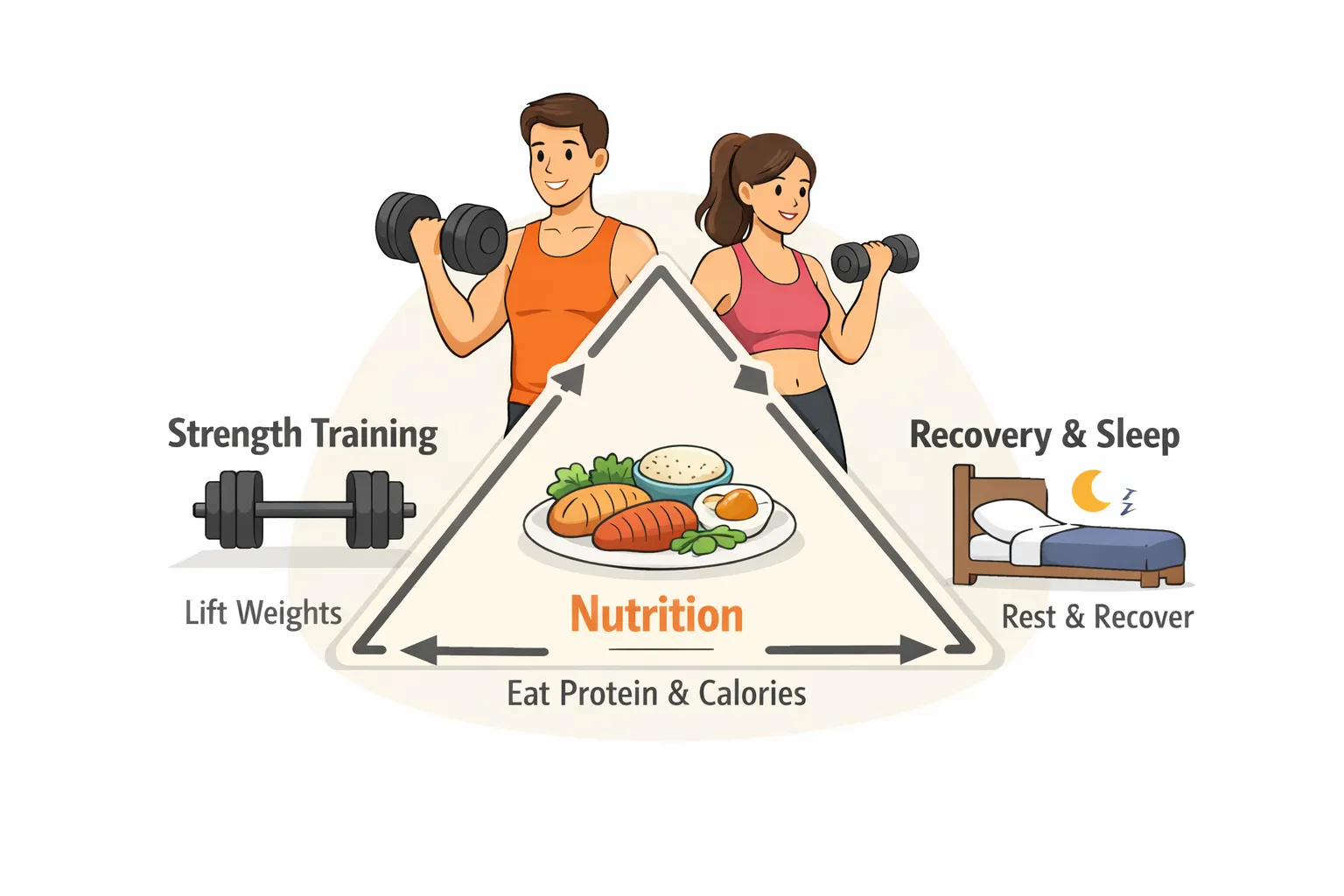
The Core Basics of Muscle Growth
How Much Should a Beginner Eat to Build Muscle?
To build muscle, beginners need a small and controlled calorie surplus, not aggressive overeating. Consuming approximately 300–400 calories above your normal daily intake provides enough energy to support training, recovery, and muscle growth without unnecessary fat gain. There is no need for dirty bulking or junk food, steady progress comes from eating slightly more of the right, nutrient-dense foods consistently.
How Much of a Calorie Surplus Do Beginners Need?
Most beginners make the best progress with a small daily calorie surplus of approximately 250–400 calories above maintenance. This range is enough to support muscle growth while keeping fat gain under control. Larger surpluses do not speed up muscle building and usually result in unnecessary fat gain.
A controlled surplus allows the body to recover from training and gradually add lean muscle mass without overwhelming the digestive system or hormones.
Simple rule:
Eat a little more, consistently, while avoiding dirty bulking or an overeating mindset.
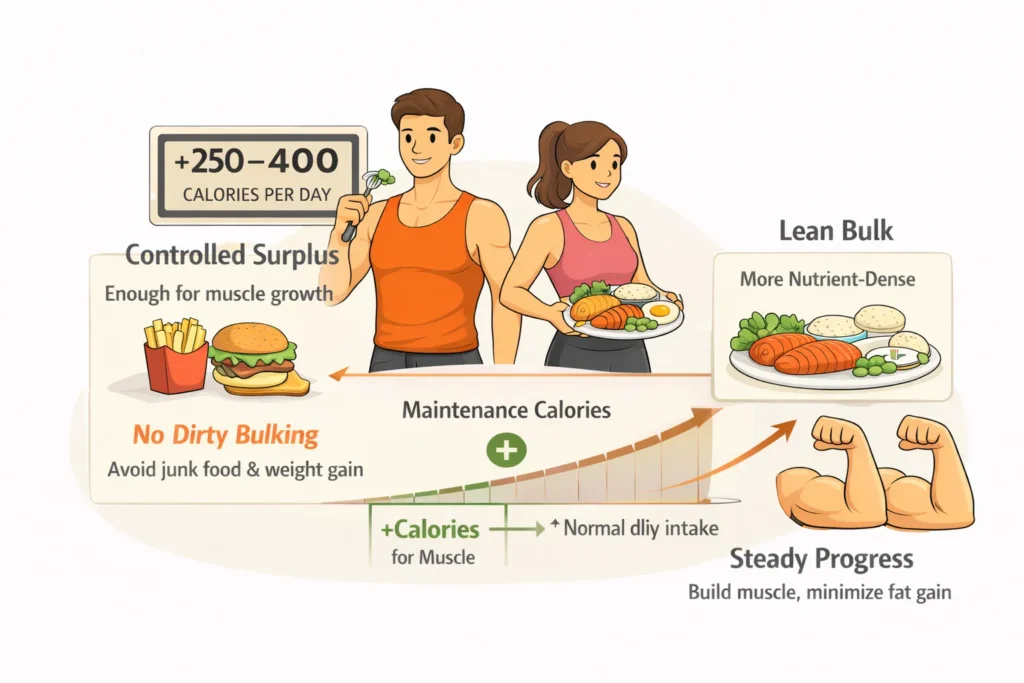
Ideal Weight Gain Speed (Lean Bulk Target)
A practical way to track whether your calorie intake is correct is by monitoring weekly bodyweight changes.
Target rate: 0.25–0.5% of bodyweight per week
Example: 75 kg beginner → ~0.18–0.38 kg gain per week
If weight is increasing faster than this, calories are likely too high.
If weight is not increasing at all after 2 weeks, calories may be too low.
Beginner Lean Bulk Reference Table
| Bodyweight | Weekly Gain Target | Daily Calorie Surplus |
| 60 kg | 0.15–0.30 kg | +250–400 kcal |
| 70 kg | 0.18–0.35 kg | +250–400 kcal |
| 80 kg | 0.20–0.40 kg | +250–400 kcal |
This approach aligns with the position stand of the International Society of Sports Nutrition (ISSN).
Protein Intake for Muscle Growth: The Only Rule Beginners Need
For beginners, protein intake doesn’t need to be complicated. Muscle growth depends more on daily protein consistency than on perfect timing or expensive supplements. A simple and effective rule is to consume 1.6–2.2 grams of protein per kilogram of bodyweight per day. This range provides your muscles with enough building material to recover and grow from regular strength training. Instead of stressing about exact numbers at every meal, beginners should focus on hitting their daily protein target most days of the week. Long-term consistency matters far more than perfect protein intake on any single day.
Protein Intake Examples by Age (Beginners)
| Age Group | Example Bodyweight | Daily Protein Target (1.6–2.2 g/kg) | Key Focus for Beginners |
| 18–25 years | 65 kg | 104–143 g/day | Fast recovery, strong training output |
| 26–35 years | 70 kg | 112–154 g/day | Busy schedule, consistency matters |
| 36–45 years | 75 kg | 120–165 g/day | Recovery, sleep, digestion focus |
| 45+ years | 70 kg | 112–154 g/day | Muscle preservation + steady growth |
International research and expert nutrition guidelines support these protein intake recommendations:
Carbohydrates & Fats for Performance and Recovery
Carbohydrates and fats are essential nutrients that support workout performance, muscle recovery, and long-term muscle growth, especially for beginners. Carbohydrates provide the primary energy source for strength training, helping improve workout intensity, strength output, and endurance. Adequate carbohydrate intake also helps replenish muscle glycogen after exercise, which supports faster recovery and consistent training progress.
Fats play an important role in hormonal health, nutrient absorption, and overall calorie balance, all of which are necessary for sustainable muscle gain. Instead of following extreme low-carb or low-fat diets, beginners should focus on balanced meals that include quality carbs and healthy fats alongside sufficient protein. When carbohydrates, fats, and protein are properly balanced, training performance improves, recovery becomes more efficient, and muscle gain is easier to maintain.
Carbohydrates & Fats Intake by Age (For Beginners)
| Age Group | Example Bodyweight | Carbohydrates (g/day) | Fats (g/day) | Beginner Focus |
| 18–25 years | 65 kg | 195–325 g (3–5 g/kg) | 39–65 g (0.6–1.0 g/kg) | High energy, strong workouts |
| 26–35 years | 70 kg | 210–350 g | 42–70 g | Performance + recovery balance |
| 36–45 years | 75 kg | 225–340 g (slightly lower end) | 45–75 g | Recovery, digestion, joint care |
| 45+ years | 70 kg | 180–300 g | 45–70 g | Muscle preservation, steady energy |
International Research on Carbohydrates & Fats (For Muscle Growth)
● Carbohydrates are the primary fuel for resistance training and improve workout performance.
● Better training performance leads to greater strength gains and muscle growth over time.
● Dietary fats support hormonal health, recovery, and overall calorie balance.
● For beginners, total daily intake matters more than extreme timing strategies.
These findings are supported by large-scale reviews, position stands, and clinical research in sports nutrition.
Meal Timing for Beginners (What Matters, What Doesn’t)
For beginners, meal timing is far less important than many people assume. What truly drives muscle growth is consistently meeting daily calorie and protein needs, not eating at perfectly scheduled times. Eating before a workout can help improve energy and focus, while eating afterward supports recovery, but there is no strict “anabolic window” that determines success or failure. Research and real-world training experience both show that muscle growth depends more on overall daily intake than precise timing. Beginners will make better progress by spreading protein across 3–4 balanced meals and ensuring they feel adequately fueled for training, rather than stressing over exact meal timing.
Training early in the morning with no fuel at all can often lead to low energy and weakness, especially for beginners.
Meal Timing for Beginners (3-4 Meals Per Day)
| Meal Time | Meal Goal | Example Foods (Non-Veg) | Example Foods (Veg) |
| Meal 1 (Morning) | Protein + carbs to start the day | Eggs + oats + fruit | Paneer/tofu + oats + fruit |
| Meal 2 (Midday) | Main balanced meal | Chicken + rice/roti + veggies | Paneer/soy + rice/roti + veggies |
| Meal 3 (Pre/Post-Workout) | Energy + protein | Banana + milk OR dal-chawal | Banana + milk OR dal-chawal + curd |
| Meal 4 (Evening/Dinner) | Protein-focused recovery | Fish/chicken + roti/potatoes | Paneer/tofu + roti/potatoes |
According to international sports nutrition research, muscle growth in beginners depends more on total daily protein intake, overall calorie balance, and consistent training than on strict meal timing. Studies show that consuming protein across 3–4 meals per day, with carbohydrates around training sessions, is sufficient to support muscle protein synthesis, workout performance, and recovery. Exact timing (such as eating every 2 hours or within a strict “anabolic window”) is not necessary for beginners.
International Research & Official Websites
Vegetarian & Indian Options (Included in Meal Template)
Vegetarian and Indian diets can fully support muscle growth when protein intake is planned properly. Beginners can replace chicken or fish with paneer, tofu, soy chunks, or dal combined with rice or roti. The key is meeting daily protein and calorie targets consistently, not the choice between vegetarian or non-vegetarian foods.
Supplements for Beginners: What’s Useful and What to Skip
Most beginners can meet their nutrition needs through a balanced, natural whole-food diet without relying on supplements. Real foods provide complete nutrition that supports digestion, long-term health, and sustainable muscle growth. Supplements may seem like a shortcut, but for most beginners, they are unnecessary and should only be considered when there is a real need.
Key points beginners should remember:
● Natural whole foods come first, they provide nutrients supplements cannot fully replace
● Supplements are not mandatory for beginner muscle growth
● Use supplements only when necessary, such as for deficiencies or higher training demands
● Medical or professional guidance is important before adding supplements
● A strong food foundation builds long-term results, not dependency
Beginner food guide for muscle nutrition and simple meals.
Hydration, Sleep, and Recovery for Muscle Growth
Muscle growth doesn’t happen in the gym, it happens during recovery. Proper hydration, quality sleep, and adequate rest allow the body to repair muscle fibers, restore energy, and adapt to training stress. Without enough water and sleep, strength levels drop, recovery slows, and muscle growth becomes harder, even with a good diet and workout plan.
Why hydration, sleep, and recovery matter:
● Hydration: Supports muscle function, nutrient delivery, and workout performance
● Sleep: Triggers muscle repair and growth through hormonal release
● Recovery: Prevents overtraining and allows consistent progress
● Consistency: Better recovery leads to better training and long-term muscle gains
Common Beginner Mistakes That Slow Muscle Gain
Many beginners fail to see muscle growth not because they lack effort, but because small daily habits quietly slow their progress. Muscle gain is a long-term biological process that depends on consistency, adequate nutrition, proper recovery, and patience. When these basics are ignored, even unintentionally, the body struggles to stay in a muscle-building state. Over time, these mistakes reduce training performance, slow recovery, and create frustration, even when workouts feel intense.
The most common mistakes beginners make include:
● Eating inconsistently or under-eating on busy days, which prevents a steady calorie surplus
● Consuming too little protein from regular meals and relying only on shakes
● Expecting fast results and frequently changing diet or workout plans
● Ignoring sleep and recovery, leading to fatigue and poor muscle repair
● Over-focusing on supplements while neglecting whole foods and hydration
● Skipping progress tracking, making it hard to adjust calories correctly
When beginners correct these habits and focus on simple, repeatable routines, muscle gain becomes more predictable and sustainable. Progress may feel slow week to week, but over months, consistency always outperforms shortcuts.
Conclusion: The Simple Formula for Beginner Muscle Growth
Building muscle as a beginner doesn’t require extreme diets, perfect timing, or excessive supplements. Real results come from a simple, consistent approach based on natural foods, adequate protein, a small calorie surplus, proper training, and recovery.
When beginners focus on the basics and stay consistent over time, muscle growth becomes predictable and sustainable. Keep it simple, trust the process, and this beginner muscle-building diet plan will deliver real results.
Simple Food Plan Guide
Start Strong Today
Better flexibility? Try Yoga for Beginners
Best Shoulder Exercises for Beginners
Top 5 Beginner Muscle Exercises
How to Lose Belly Fat in 30 Days (Beginner Guide)
FAQs
Can I build muscle without supplements?
Yes. Supplements are optional, not required.
Is a calorie surplus necessary for beginner muscle growth?
Yes, a small calorie surplus is important for muscle growth. Without extra energy, the body struggles to build new muscle tissue. Beginners generally make the best progress with a controlled surplus of 250–400 calories per day, which supports muscle gain without excessive fat gain.
How much protein do beginners really need per day?
Beginners should aim for 1.6–2.2 grams of protein per kilogram of bodyweight per day. This range provides enough building material for muscle repair and growth. The focus should be on meeting the daily total consistently rather than worrying about exact protein amounts at every meal.
Is this diet good for skinny beginners?
Yes. Skinny beginners benefit the most from consistent eating.
Should beginners avoid carbs?
No. Carbs fuel workouts and help muscle growth.
Is meal timing important for beginner muscle gain?
Meal timing is far less important than total daily intake. While eating before and after workouts can help with energy and recovery, there is no strict “anabolic window” beginners must follow. Spreading protein across 3–4 balanced meals per day is more than enough to support muscle growth.
Can vegetarians build muscle as effectively as non-vegetarians?
Yes, vegetarians can build muscle just as effectively when protein intake is planned properly. Foods like paneer, tofu, soy, dal, milk, curd, and legumes can easily meet protein requirements. Consistency in calories and protein matters more than whether the diet is vegetarian or non-vegetarian.
Affiliate Disclosure: This page may contain affiliate links. If you purchase through these links, we may earn a small commission at no extra cost to you.

Ajay Jaswal is the founder of Fitness Dose Club, where he shares beginner-friendly guides on posture improvement, fitness training, and responsible supplement use. His goal is to make healthy living simple, practical, and safe for everyday people.